Understanding the neuroscience behind RTT, subconscious beliefs and why lasting change often begins beneath the surface.
Have you ever found yourself doing something you know isn't good for you, promising yourself that this time will be different, only to find yourself back in exactly the same position a few days or weeks later?
Perhaps you know you need to stop overthinking, but your mind simply won't switch off, or you understand perfectly well that you don't need to please everybody, yet the thought of disappointing somebody still leaves you feeling uncomfortable. Maybe you've recognised that alcohol, cocaine or another habit has gradually become your way of managing stress, and although you genuinely want to stop, something keeps pulling you back.
It can be incredibly frustrating, particularly when you're somebody who is used to being capable, making decisions and solving problems in every other area of your life, because you know what you need to do, you understand the consequences of continuing as you are, and yet somehow that knowledge doesn't seem to be enough to change how you feel or behave.
You might even find yourself asking, “Why can’t I just get a grip on this?”
But what if the problem isn't that you're not trying hard enough? What if the behaviour you're struggling with is being influenced by something you've learned over many years, something that happens automatically, without you consciously deciding to do it?
To understand why this happens, we need to look at how our brains develop, how emotional experiences influence the way we see ourselves and why some of the patterns we learned earlier in life can continue to affect us long after the circumstances that created them have changed.
And this is where the neuroscience behind Rapid Transformational Therapy, or RTT, becomes particularly interesting.
Your brain is constantly learning, even when you don't realise it
In his fascinating book, The Little Book of Big Stuff About the Brain, neurologist and neurobiologist Dr Andrew Curran explores how our brains develop, how we learn and how our experiences and emotions influence the way we think, feel and behave.
What I particularly like about understanding the brain in this way is that it helps explain why so much of what we do isn't necessarily the result of a conscious decision, but rather the consequence of things we've learned through our experiences, relationships and the meanings we've attached to them.
Our brains contain billions of nerve cells that communicate through electrical and chemical signals, forming networks that are continually influenced by what we experience throughout our lives, and although we often think of learning as something we do deliberately, such as learning to drive or studying for an exam, our brains are also learning from the emotional experiences we have every single day.
Imagine, for example, a child who grows up receiving lots of praise for being helpful, achieving good grades and never causing any problems. Over time, that child might begin to associate being loved and accepted with being good, being successful or putting everybody else first, and although nobody has necessarily told them that they must be perfect to be worthy of love, that may be the meaning they have taken from their experiences.
Now imagine that same child thirty years later. They're a successful business owner, they have a family, people rely on them and, from the outside, they appear to have everything under control, but privately they struggle to delegate, feel responsible for everybody, find it almost impossible to relax and experience anxiety whenever they think they've disappointed somebody.
Consciously, they know they don't have to do everything. They know they're allowed to rest, they know other people are capable of making decisions and they know that making a mistake doesn't mean they're a failure. But emotionally, something very different may be happening.
Their brain may have learned an association between achievement, approval and feeling safe, and that association can continue to influence their behaviour even when it no longer makes sense in their present circumstances. This is the kind of underlying pattern we explore through RTT, because sometimes the thing you are struggling with today makes much more sense when you begin to understand what your brain learned along the way.
Why your subconscious mind can keep you stuck in patterns you want to change
When we talk about the subconscious mind, we're really talking about the many processes that influence our thoughts, feelings and behaviour without us being consciously aware of them. There isn't one particular part of the brain where the subconscious lives, but there are networks involved in memory, emotional learning, automatic responses and habits that can influence what we do before we've even had time to think about it.
Think about learning to drive. When you first started, you had to concentrate on absolutely everything, from changing gears and checking your mirrors to remembering which pedal did what, but eventually, through repetition, much of it became automatic. You no longer needed to consciously think about every individual movement because your brain had learned the pattern.
Now imagine that the same principle applies to some of your emotional responses. If you've repeatedly experienced criticism, rejection, unpredictability or pressure, your brain may have learned to respond to certain situations with anxiety, avoidance, people-pleasing or a need to control everything around you.
You don't necessarily choose to feel those things, and you may not even understand why you react so strongly, but the response can happen automatically because your brain has learned an association between a particular situation and a particular emotional response. And because you've been responding in that way for so long, it can begin to feel like part of your personality.
You might find yourself saying, “I’m just an anxious person,” or “I’ve always been a people-pleaser,” or perhaps, “I can’t relax unless everything is done.” But what if those responses aren’t simply who you are? What if some of them are patterns you’ve learned, often for very understandable reasons, that are no longer helping you live the way you want to?
This is one of the most important things I want my clients to understand, because when you begin to recognise that a response may have been learned, it opens up the possibility that you can learn a different way of responding.
Your brain is trying to protect you, even when the response is no longer helpful
Our brains are constantly interpreting information and helping us respond to the world around us, and one of their important functions is recognising potential threats and preparing us to deal with them. Several areas of the brain work together in this process, including the amygdala, which is involved in processing emotionally significant information, the hippocampus, which plays an important role in memory and context, and the prefrontal cortex, which contributes to planning, decision-making and regulating our responses.
When we're feeling particularly anxious or overwhelmed, these systems can influence the way we think and behave, which helps explain why it can become so difficult to think clearly or respond rationally when something has triggered a strong emotional reaction.
Imagine you've grown up in an environment where making mistakes resulted in criticism, conflict or disappointment. Your brain may have learned that mistakes are something to avoid because, at the time, avoiding them helped you feel safer or more accepted.
Years later, you receive a perfectly ordinary email from your manager questioning something you've done, and although your rational mind knows that one email doesn't mean your career is in danger, you suddenly feel anxious, start replaying conversations in your head and spend the rest of the evening worrying about what you've done wrong.
You might work late to make sure everything is perfect, seek reassurance from somebody else or find yourself unable to relax until the situation has been resolved. To somebody looking in from the outside, your reaction might seem completely disproportionate, but when we understand that your brain may have learned to associate criticism with threat, the response begins to make more sense.
This doesn't mean every emotional response is caused by childhood experiences, or that every difficulty has one hidden cause, but it does help us understand why exploring the beliefs and associations behind a response can be valuable. Rather than simply asking, 'What's wrong with me?', we can begin asking, 'What has my brain learned, and is that learning still helping me?'
Why we develop habits that make us feel better temporarily, even when we know they're causing problems
This is something I see frequently in my work with professionals and business owners who are struggling with anxiety, stress and addictive habits. Many of the people I work with are incredibly capable, successful individuals who manage businesses, lead teams, provide for their families and carry considerable responsibility, but behind the scenes they are often exhausted, their minds are constantly working and they have gradually developed ways of coping with the pressure that are beginning to cause problems of their own.
For some, that's alcohol or cocaine. For others, it might be gambling, overworking, excessive exercise or another behaviour that provides a temporary escape from how they're feeling. And although these behaviours can look very different, they can sometimes serve a similar emotional purpose.
Imagine you've had an incredibly stressful week, you've been making decisions all day, everybody seems to need something from you and, by the time Friday arrives, all you want is to stop thinking for a few hours. You have a drink, use cocaine or engage in another behaviour that provides some temporary relief, and for a little while, the pressure seems to disappear.
Your brain begins to associate that behaviour with feeling better. The next time you are overwhelmed, the urge appears again, and as the pattern is repeated, the association can become increasingly automatic. This is an example of reinforcement learning, where a behaviour becomes more likely to happen again because of the relief or reward associated with it.
Of course, addiction is more complex than a learned emotional response alone, and genetics, brain chemistry, environment and other factors can all contribute, but understanding what a behaviour is doing for somebody emotionally can be an important part of helping them change it.
Understanding the High-Functioning Pressure Loop
In my work, I describe this pattern as the High-Functioning Pressure Loop:
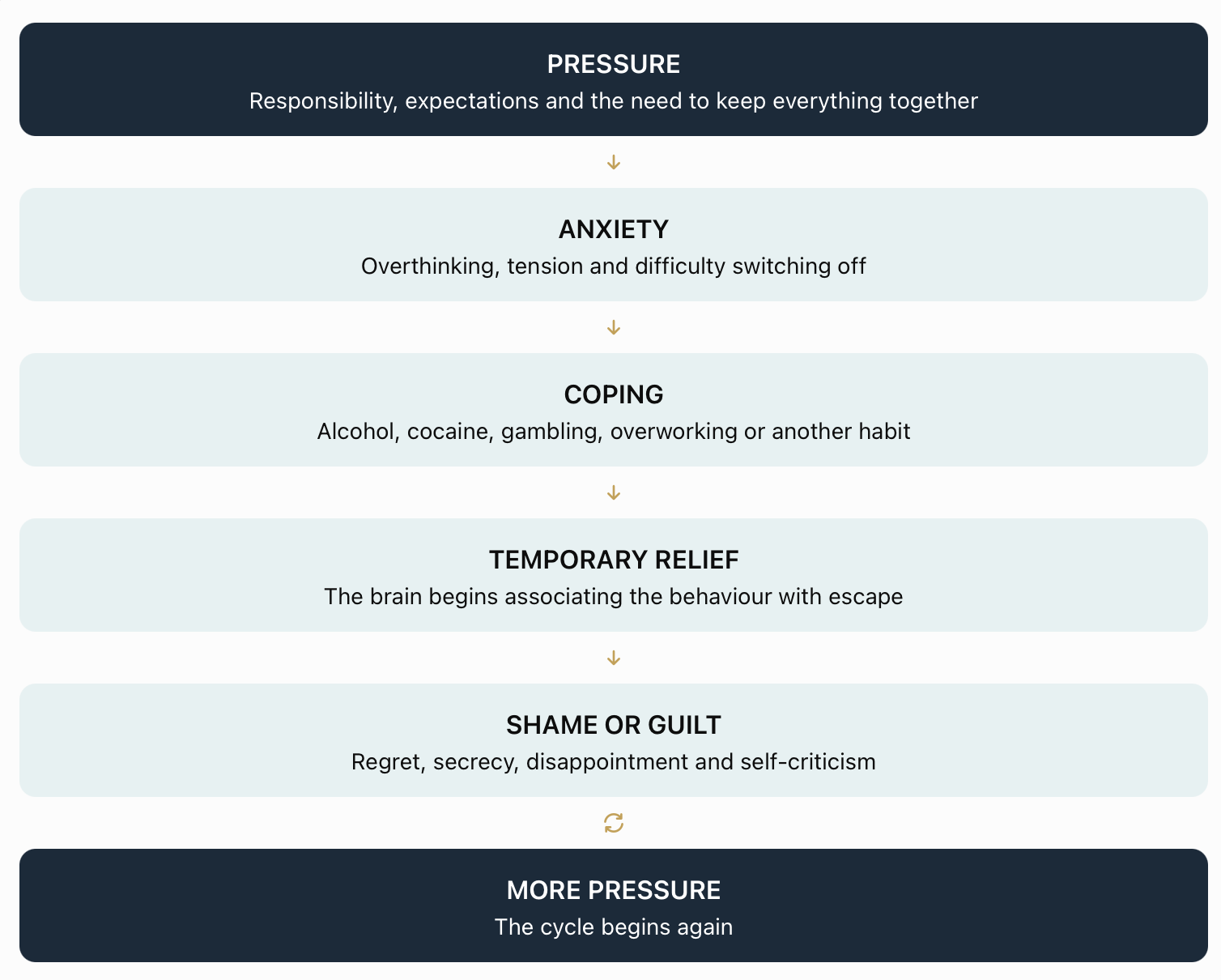
What I find particularly important about understanding this cycle is recognising that the coping behaviour may not be the original problem, but rather something the person has learned to do in response to the pressure or emotional discomfort they're experiencing. If we only concentrate on stopping the behaviour, without exploring what's driving the need for it in the first place, we may leave an important part of the problem untouched.
And this is why my approach focuses on understanding the pattern, addressing the beliefs and emotional responses that may be contributing to it, and helping clients develop healthier ways of managing the situations that previously triggered the behaviour.
Neuroplasticity: your brain can learn something new
One of the most encouraging things we know about the brain is that it isn't permanently fixed in the patterns it developed during childhood. Throughout our lives, our brains retain the ability to adapt in response to new experiences, learning and practice, a process known as neuroplasticity.
This matters because a response that has become automatic is not necessarily permanent, and although changing a deeply established pattern may take time and repetition, the brain is capable of developing new ways of responding.
Imagine somebody who has spent years believing that they must always be in control. They might understand intellectually that other people are perfectly capable of making decisions, but emotionally they feel uncomfortable whenever they have to delegate, because somewhere along the way they have associated being in control with feeling safe.
Through therapy, they begin to recognise that association, understand why it may have developed and explore the possibility that they can still be safe, valued and capable without having to manage absolutely everything. They then begin practising different responses in everyday life, perhaps delegating a task, allowing somebody else to make a decision or taking time off without feeling guilty.
Each new experience gives the brain an opportunity to learn that the feared outcome does not necessarily happen. This is one of the reasons I place so much importance on the work that happens after an RTT session, because understanding where a pattern may have developed is valuable, but learning to respond differently in everyday situations is what helps that understanding become part of your life.
Can we change the emotional meaning of something that happened in the past?
This is where another fascinating area of neuroscience becomes relevant to RTT. For many years, memories were often thought of as relatively fixed recordings of past events, but research has shown that memory is much more dynamic than that, and under certain conditions, recalling a memory can make aspects of it open to updating through a process known as memory reconsolidation.
In simple terms, this means that when we revisit an emotional memory and encounter new information or a different perspective, there may be an opportunity for new learning to influence the way that memory affects us.
Imagine somebody who remembers being humiliated at school. Perhaps they were laughed at in front of the class, criticised by a teacher or made to feel that they weren't clever enough, and although they've gone on to achieve considerable success as an adult, they still carry the belief that they're somehow not good enough.
They might constantly compare themselves with others, struggle to accept compliments or feel anxious whenever they are asked to speak in front of a group. During therapy, they may revisit that experience from their current adult perspective and begin to recognise that the conclusion they reached as a child was not necessarily an accurate reflection of who they were.
Perhaps the experience said more about the behaviour of the person who humiliated them than it did about their own worth. The event itself has not changed, but the meaning they have attached to it may begin to change, and when that meaning changes, the emotional response associated with it may change too.
This is an important principle behind the reframing work used in RTT, although memory reconsolidation is a complex scientific process, and we cannot assume that every therapeutic reframe produces it or that memories are permanently rewritten. The purpose of exploring earlier experiences is not to erase the past, but to help somebody develop a healthier understanding of themselves and the experiences that may have influenced them.
So how does Rapid Transformational Therapy actually work?
RTT combines hypnosis with therapeutic exploration, reframing and other psychological techniques to help clients understand and address the patterns that may be contributing to their difficulties. The way I use RTT is centred around understanding not just what's happening, but why it may be happening, because very often somebody has already spent years trying to manage the symptom without fully understanding the beliefs or emotional associations that may be contributing to it.
First, we explore the pattern
Before trying to change anything, we look at what is happening in your life, what triggers the response and what you experience emotionally before, during and afterwards. For somebody struggling with anxiety, that might involve understanding why particular situations create such a strong reaction, while for somebody struggling with an unwanted habit, we might explore what the behaviour provides and what they are trying to escape or manage when the urge appears.
Sometimes people begin to recognise connections they have never considered before, such as the relationship between their need for control and their fear of making mistakes, or the way they have learned to associate achievement with feeling valued.
Then we use hypnosis to explore beneath conscious awareness.
Hypnosis is a state of focused attention in which a person may become more responsive to therapeutic suggestion, and although it's often portrayed in films as somebody being unconscious or losing control, that's not what happens during a therapeutic session. You're still involved in the process, you can communicate with me and you're not surrendering control of your mind.
Brain-imaging research has identified changes in activity and communication between networks involved in attention, self-awareness and cognitive control during hypnosis, which helps us understand why it can provide a useful setting for focused therapeutic work.
During an RTT session, we use that focused state to explore relevant experiences, emotions and beliefs that may be contributing to the present problem. We're not assuming that every issue began in childhood, and we're certainly not looking to blame parents or suggest that every difficulty has one hidden cause, but we are looking for connections that may help explain why a particular response has become so established.
It's also important to understand that memory is reconstructive, and hypnosis doesn't guarantee accurate recall, so the purpose of exploring memories is to understand the meaning somebody attaches to their experiences rather than treating everything recalled as verified historical fact.
We challenge the old meaning
Once we have identified a belief that may be contributing to the problem, we can begin to question it. Is it actually true? Was it ever true? Was it simply the conclusion you reached at a time when you did not have the understanding, experience or resources you have now?
For example, a child might interpret a parent's emotional unavailability as evidence that they're not lovable, whereas an adult can recognise that somebody else's inability to provide emotional support doesn't determine their worth. That new understanding can create an opportunity to develop a different emotional response.
And rather than simply repeating positive statements, the aim is to help the client develop a perspective that feels meaningful, believable and relevant to their life today.
Finally, we reinforce the new learning
Following the RTT session, I create a personalised transformational audio based on the work we've completed together, which clients listen to regularly as part of their integration. The purpose is to reinforce the new perspective and support the development of healthier responses, while the practical work that follows gives clients opportunities to apply what they've learned in everyday situations.
If you've worked on the belief that you must always put everybody else first, for example, you need opportunities to practise setting boundaries, and if you've been relying on alcohol to manage pressure, you need alternative ways to respond to stress and the situations that previously triggered the urge. The audio supports the therapeutic work, but meaningful change also involves what happens outside the session.
Why can RTT sometimes produce change relatively quickly?
One of the questions people often ask me is why RTT can be delivered over a relatively short period compared with some other therapeutic approaches. Part of the answer lies in the way the process is structured, because rather than concentrating exclusively on discussing the symptom, RTT brings together therapeutic exploration, hypnosis, reframing and integration within a focused approach.
For some clients, recognising a connection they had not previously understood can be a significant turning point. They may have spent years believing that their anxiety, lack of confidence or unwanted habits are simply part of who they are, and when they begin to understand how those responses may have developed, they can start relating to themselves differently.
That does not mean everybody experiences immediate change, or that one session can resolve every difficulty, because the time required will depend on the individual, the complexity of the problem and the circumstances surrounding it.
Research supports hypnosis as a potentially useful intervention for some conditions, including anxiety, but research specifically establishing the effectiveness of RTT as a complete, distinct method remains limited. For complex trauma, substance dependence or significant mental health difficulties, additional or specialist support may also be appropriate.
What matters is finding an approach that addresses your individual circumstances rather than assuming that one method will work for everybody.
Why understanding the root of a problem can make such a difference
One of the things I find most rewarding about my work is seeing somebody begin to understand themselves in a way they haven't before, because very often they've spent years feeling frustrated with themselves, believing they should be able to manage their anxiety, stop a particular behaviour or simply think their way out of how they're feeling.
But when we begin to explore the pattern, something can shift. They start to recognise that their need for control may be connected to feeling unsafe, that their people-pleasing may have developed from a fear of rejection, or that the habit they have been trying so hard to stop has become a way of managing emotional discomfort they have not known how to deal with differently.
And once we understand those connections, we can begin working on the beliefs, emotional responses and behaviours that are contributing to the problem, rather than concentrating exclusively on trying to suppress the symptom.
The goal isn't to become somebody completely different, and it certainly isn't to spend the rest of your life analysing everything that happened in your childhood. It's to understand yourself well enough to recognise the patterns that are no longer helping you, develop healthier ways of responding and begin feeling more comfortable being yourself, without the constant pressure, anxiety or unwanted habits that have been taking up so much of your life.
Your brain has spent years learning how to respond to the world around you, and it still has the capacity to learn. Sometimes the most useful question is not, “How do I force myself to stop doing this?” It is, “What is driving this pattern, and what needs to change underneath it?” That is where our work begins.
Frequently Asked Questions About RTT and the Brain
What is the neuroscience behind Rapid Transformational Therapy?
RTT draws on principles associated with emotional learning, memory, neuroplasticity and hypnosis, exploring how our experiences and learned beliefs may influence the way we think, feel and behave. By combining therapeutic exploration with hypnosis, reframing and integration, RTT aims to help clients understand patterns that may be operating outside conscious awareness and develop healthier responses. Although several of the principles used within RTT have scientific foundations, research specifically evaluating RTT as a complete treatment remains limited.
Can RTT really change subconscious beliefs?
Our beliefs are not necessarily fixed, and many of the conclusions we reach about ourselves develop through our experiences rather than through deliberate, conscious decisions. RTT aims to help clients identify beliefs that may be contributing to their difficulties, explore where those beliefs may have developed and begin creating a different understanding of themselves through therapeutic reframing and integration. The extent and speed of change vary between individuals, but the brain’s capacity to learn and adapt means that long-established patterns are not necessarily permanent.
What does addressing the root cause actually mean?
When I talk about addressing the root cause, I am referring to exploring the beliefs, emotional associations, experiences and circumstances that may be contributing to a problem, rather than concentrating exclusively on the symptom itself. For example, somebody may come to therapy because they struggle with anxiety, but through our work we might discover that their anxiety is closely connected to a fear of making mistakes, a need for approval or a belief that they must always be in control. That understanding gives us something more meaningful to work with, although not every difficulty has one identifiable cause.
Why do I keep repeating behaviours when I know they are bad for me?
Because knowing something intellectually does not automatically change the emotional associations and learned responses that influence your behaviour. If a particular habit has repeatedly provided relief from stress, anxiety or another uncomfortable feeling, your brain may have learned to associate that behaviour with feeling better, making it more likely that you will return to it when the same emotions appear. Understanding what triggers the behaviour and what it provides can help you begin developing healthier ways of responding.
Can hypnotherapy help with anxiety and overthinking?
Hypnotherapy may help some people manage anxiety by supporting focused attention, relaxation and changes in unhelpful thought patterns. Research has found beneficial effects for hypnosis in anxiety treatment, particularly when combined with other psychological approaches, although outcomes vary and it is not necessarily suitable as a standalone treatment for every anxiety condition. In my work, I also explore the beliefs and emotional patterns that may be contributing to the anxiety, rather than focusing exclusively on helping somebody relax.
Can RTT help with addictive habits such as alcohol or cocaine use?
RTT may form part of a broader approach to understanding the emotional triggers, beliefs and coping patterns associated with substance use, particularly where somebody has developed a habit of relying on alcohol or cocaine to manage pressure, anxiety or uncomfortable emotions. However, addiction is complex and can involve physical dependence, changes in reward processing, mental health difficulties and environmental factors, so specialist addiction treatment, medical assessment and ongoing support may also be necessary. RTT should not be considered a proven standalone treatment for substance dependence.
Does RTT involve going back to childhood?
Sometimes we explore earlier experiences where they appear relevant to the present difficulty, but that does not mean every problem began in childhood or that we need to revisit the past unnecessarily. The purpose is to understand the meanings and emotional associations that may have developed through your experiences, and whether they are still influencing how you respond today.
Can you change a belief you have held for years?
Yes, beliefs and learned responses can change through new experiences, reflection, therapeutic work and repeated practice. This is related to neuroplasticity, the brain’s ability to adapt through learning and experience, although deeply established patterns may take time to change and understanding something intellectually does not always immediately change the associated emotional response.
How quickly can RTT work?
Some clients experience meaningful changes in their understanding or emotional responses following an initial session, while others benefit from additional sessions and ongoing integration. The time required depends on the individual, the complexity of the problem and their wider circumstances, so although RTT is designed as a focused therapeutic approach, rapid or permanent results cannot be guaranteed.
Will I lose control during hypnosis?
No. Hypnosis is not unconsciousness or mind control, and you remain involved in the therapeutic process throughout the session. You can communicate with me, you are aware of what is happening and the work is guided by the goals we have agreed together.
Do I need to know what is causing my problem before starting RTT?
Not at all. Many of my clients know exactly what they want to change but have no idea why the pattern developed, and part of our work involves exploring the experiences, beliefs, emotional responses and triggers that may be contributing to the difficulty. You do not need to arrive with all the answers.
Ready to understand what's driving your own patterns?
If you're struggling with anxiety, stress, overthinking or an unwanted coping habit, you may already have spent considerable time trying to change things on your own, perhaps reading the books, making the promises, trying different strategies and genuinely understanding what you need to do, but somehow finding yourself back in the same position. And if that sounds familiar, it may be worth exploring what's happening beneath the surface.
I’m Nikki Brooke, a Rapid Transformational Therapist specialising in high-functioning anxiety, addictive habits and the emotional patterns that often sit behind them. I work with professionals, business owners and individuals who appear to be coping on the outside but privately feel overwhelmed, anxious or increasingly reliant on habits to switch off, helping them understand the patterns that may be contributing to their difficulties and develop healthier ways of responding. See what my previous clients have experienced working with me
My approach combines subconscious belief work with practical support, because understanding why something happens is valuable, but being able to respond differently in everyday life is what really matters. Sessions are confidential and available in Cardiff and online across the UK. Find out more here
Arrange a confidential consultation
Scientific References and Further Reading
1. Curran, A. The Little Book of Big Stuff About the Brain. Crown House Publishing.
2. Lane, R. D., et al. (2015). Memory Reconsolidation, Emotional Arousal, and the Process of Change in Psychotherapy. Behavioral and Brain Sciences. https://pubmed.ncbi.nlm.nih.gov/24827452/
3. Jiang, H., et al. (2016). Brain Activity and Functional Connectivity Associated with Hypnosis. Cerebral Cortex. https://stanfordhealthcare.org/publications/437/437380.html
4. Valentine, K. E., et al. (2019). The Efficacy of Hypnosis as a Treatment for Anxiety: A Meta-Analysis. International Journal of Clinical and Experimental Hypnosis. https://pubmed.ncbi.nlm.nih.gov/31251710/
5. Beckers, T., & Kindt, M. (2017). Memory Reconsolidation Interference as an Emerging Treatment for Emotional Disorders. Annual Review of Clinical Psychology. https://pubmed.ncbi.nlm.nih.gov/28375725/
This article is intended to provide general educational information about neuroscience and therapeutic approaches. RTT is not a substitute for appropriate medical care or specialist mental health or addiction treatment, and individual outcomes vary.